How to efficiently machine shaped parts on CNC mill-turn machines?


As the aerospace industry rapidly develops, demand for advanced materials is increasing. These materials must offer higher strength and longer service life at high temperatures.
At the same time, they must withstand more complex and demanding operational conditions.
Engineers prefer GH4169 nickel-based high-temperature alloy for shaft components because of its excellent properties.
The internal bore of the shaft typically requires machining to ensure a proper fit with other components.
GH4169 has a relative machinability of kv=v60(v60) j<0.15. This value places it in machinability grade 8.
As a result, people consider GH4169 a typical difficult-to-machine material.
During internal hole machining, the material exhibits several severe challenges.
It generates high cutting temperatures and large cutting forces.
It also has a strong tendency for work hardening and causes rapid tool wear.
In addition, there is substantial cutting deformation and difficulty in chip removal.
Poor visibility during machining further complicates the process.
These factors make it one of the most challenging alloy materials for internal hole drilling currently available.
Many scholars have extensively researched GH4169 drilling, but few researchers have actively explored GH4169 deep blind hole machining.
This paper focuses on the most difficult-to-machine deep blind holes in multi-step deep holes made of GH4169.
It conducts drilling tests specifically on GH4169 deep blind holes.
Researchers optimize cutting parameters based on these tests.
It aims to provide a reference for subsequent deep blind hole drilling and machining of similar materials.
Nickel-based high-temperature alloys primarily use nickel as the base material.
The nickel content typically ranges from 50% to 55%.
These alloys can withstand temperatures above 1000°C.
GH4169 is a type of nickel-based high-temperature alloy.
It has a bulk density of ρ=8.24 g/cm3.
This nickel-based high-temperature alloy strengthens itself by precipitating the body-centered cubic γ’ and face-centered cubic γ’ phases.
It exhibits excellent comprehensive properties at temperatures ranging from -253°C to 700°C.
It can withstand significant stress under oxidizing and gas corrosion conditions.
This resistance holds at temperatures between 600°C and 1000°C for prolonged use.
The mechanical properties of GH4169 nickel-based high-temperature alloy are shown in Table 1.

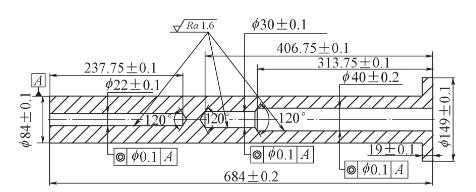
The cross-section of the multi-step deep hole is shown in Figure 1.
The large-end diameter is (149±0.1) mm, the small-end diameter is (84±0.1) mm, and the total length is (684±0.2) mm.
The diameter of the small hole at the right end is (30±0.1) mm, the hole depth is (406.75±0.1) mm, and the length-to-diameter ratio L/D is 13.6.
The diameter of the left-end hole is (22±0.1) mm, the hole depth is (237.75±0.1) mm, and the length-to-diameter ratio L/D is 10.8.
The length-to-diameter ratios of both ends are >10, and both are deep blind holes.
The design requires the coaxiality error between the three inner holes and the outer circumference to be less than 0.1 mm, and it demands high coaxiality for the three stepped holes.
The surface roughness value Ra of the inner holes must be less than 1.6 μm.
Due to the small hole diameter, chip blocking is likely to occur during machining.
This situation imposes high demands on the machine tool, cutting tools, and operators.
As a result, the machining process becomes highly challenging.
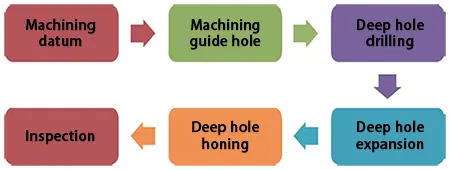
For multi-step deep blind holes, first machine a φ30mm deep hole using the outer diameter as the reference.
Use the φ30mm hole as the guide hole and enlarge the φ40mm inner hole with a front guide boring tool to ensure coaxiality between the two holes.
Next, semi-finish the outer diameter using the inner hole as the reference to ensure coaxiality between the inner hole and outer diameter.
Then, machine the left-end φ22mm inner hole using the outer diameter as the reference.
Finally, use both inner holes as the reference to finish-turn the outer diameter, ensuring the coaxiality of the multi-step holes.
The process flow is shown in Figure 2.
The machining of the φ30mm inner hole at the right end is the most critical process in the manufacturing workflow.
For the φ30mm inner hole, the first step is to drill the pilot hole.
To minimize the impact of axis deviation during deep hole machining, the operator should drill the φ25mm pilot hole first.
Currently, there are four standard deep hole drilling methods: gun drilling, BTA drilling, jet drilling, and DF drilling.
Generally, BTA drilling is chosen for large diameters, where d>20 mm.
They select gun drilling for small diameters, specifically when d ≤ 20 mm.
Jet drilling uses a dual-tube system to complete drilling through the jet suction effect.
This method is suitable for processing larger diameter holes.
DF drilling evolved from jet drilling.
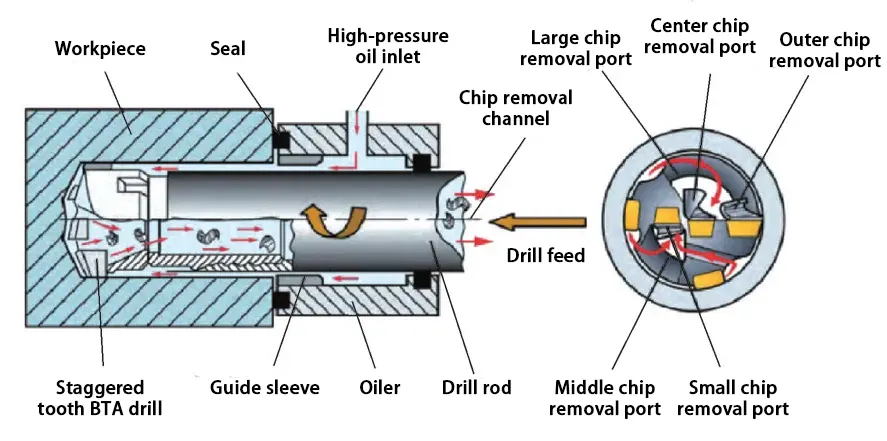
BTA (Boring and Trepanning Association) drilling is a typical self-guided internal chip removal deep hole drilling method.
The German company Beisher developed it.
Industries such as defense, aerospace, automotive, and nuclear energy widely apply this method.
Considering all factors, the team adopts the BTA internal chip removal drilling method to process a φ25 mm deep hole.
The principle of BTA internal chip removal drilling is shown in Figure 3.
The geometric angles of the BTA internal chip-removal drill are shown in Figure 4.
Based on the special characteristics of GH4169 material processing and the working conditions during BTA deep hole drilling, engineers determine the geometric angles of the BTA internal chip-removal drill cutting edge.
The specific values are shown in Table 2.
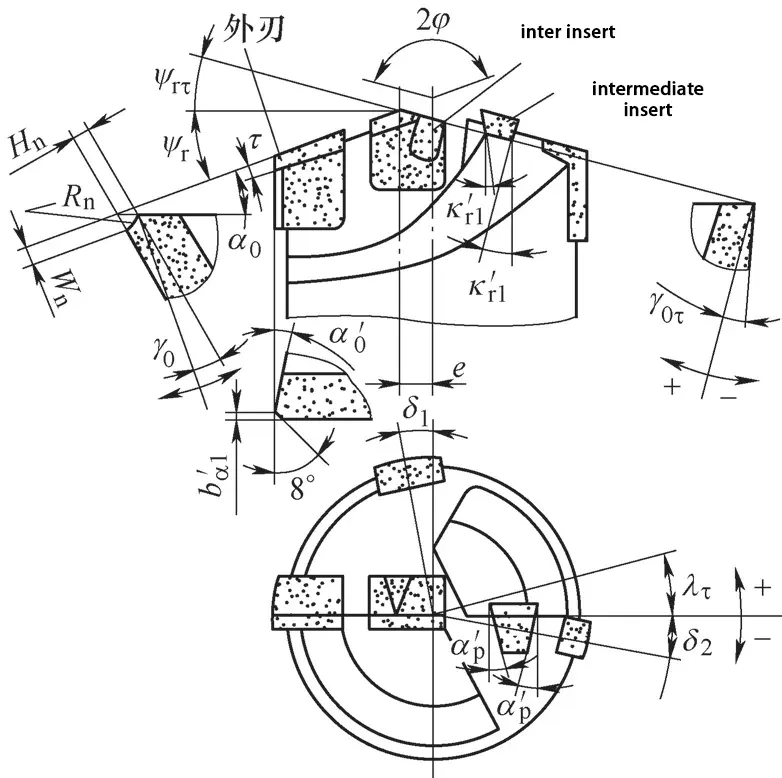

The size of the rake angle directly affects the distribution of cutting force, cutting deformation, cutting thickness, cutting width, and chip breaking.
Typically, the outer rake angle Ψr = 18°.
Generally, the front angle γ0 of each cutting edge is 0°, but for materials that are difficult to chip, γ0 can be set to 1° to 3°.
Here, the intermediate value γ0 = 2° is used.
They primarily select the rear angle α0 of the cutting edge based on the workpiece material and feed rate.
Generally, the rear angle α0 of the outer edge is 8° to 12°, with α0 set to 10°.
The rear angle α0τ of the inner edge is larger than that of the outer edge, typically ranging from 12° to 15°, with α0τ set to 13°.
The multi-edged offset-tooth deep hole drill bit has a more minor eccentricity (e) than the single-edged internal chip removal deep hole drill bit.
Because the cutting edges are distributed on both sides of the axis, this happens.
As a result, part of the radial force is offset.
The drill bit experiences less radial force than the single-edged internal chip removal deep hole drill bit.
Therefore, the eccentricity ee can be smaller.
The value of ee ranges from 0.08 to 0.1 times d0.
In this case, they select e = 2.25 mm.
The rear angle of the secondary cutting edge at the outer edge of the external teeth is typically set to α0′=8∘.
The ridge width is ba1′=0.5~ 1.5 mm.
The ridge width ba′′ is 1 mm.
The chipbreaker groove width Wn is typically 1.22 mm.
The value of Wn has a significant impact on the length of the chips.
The chipbreaker groove depth Hn is 0.3 to 0.6 mm, with Hn set to 0.4 mm.
The chipbreaker groove angle τ is 2° to 6°, with τ set to 4°.
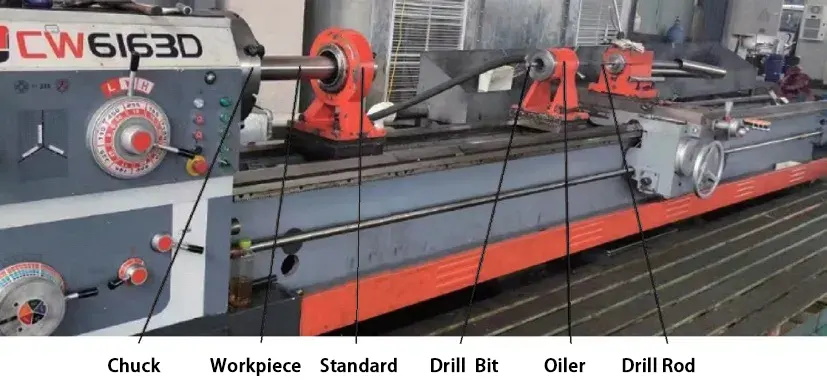
They select the CW6163D machine tool, shown in Figure 5a, for deep hole machining.
The cutting tool chosen is a 3-flute BTA deep hole drill, shown in Figure 5b.
They use YG8 as the insert material for the drill.
The machining material is nickel-based, and they select a sulfur-containing cutting fluid that provides good lubrication and chip-breaking effects.
After considering all aspects, they selected KT9932 cutting fluid.
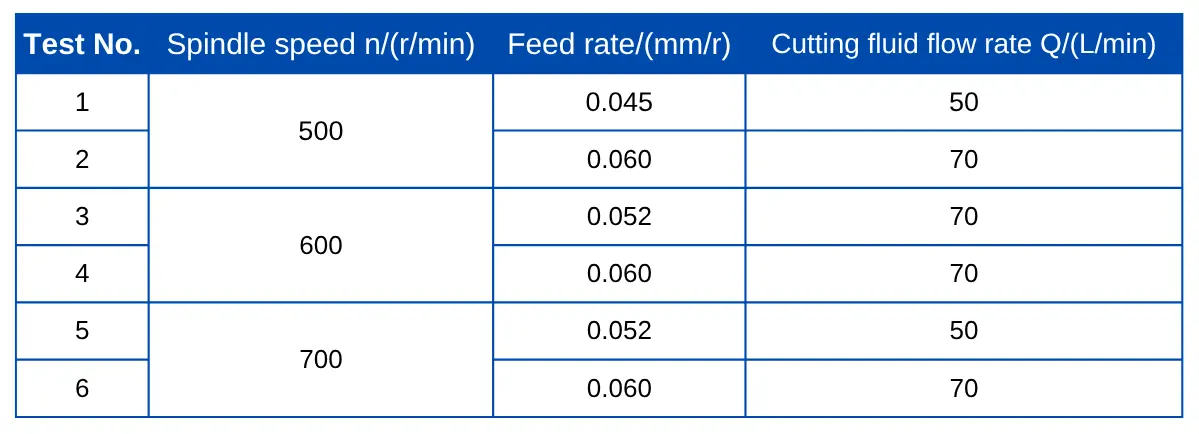
The study investigates the influence of spindle speed n, feed rate f, and coolant flow rate Q on the cutting process.
The orthogonal experimental design is shown in Table 3.
Due to the high coaxiality requirements for multi-step deep holes, the drilling process uses a method where the workpiece rotates.
Meanwhile, the tool feeds axially.
The spindle speed n and feed rate f are set at three levels, while the coolant flow rate Q is set at two levels.
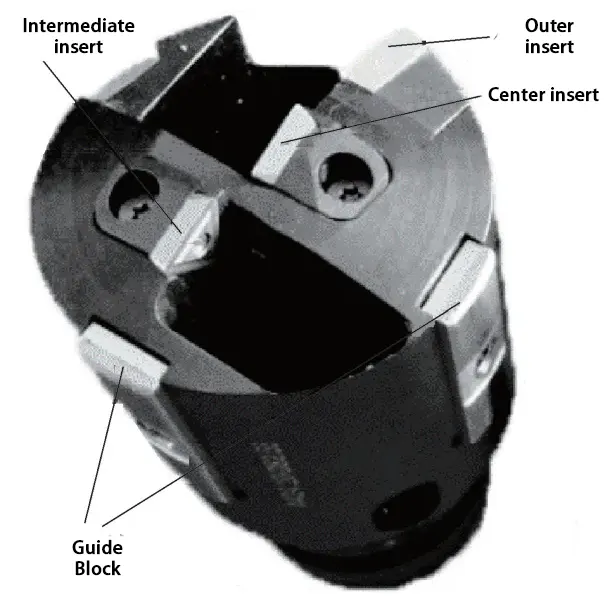
The outer teeth, center teeth, and intermediate teeth occupy 40%, 40%, and 20% of the tool radius, respectively.
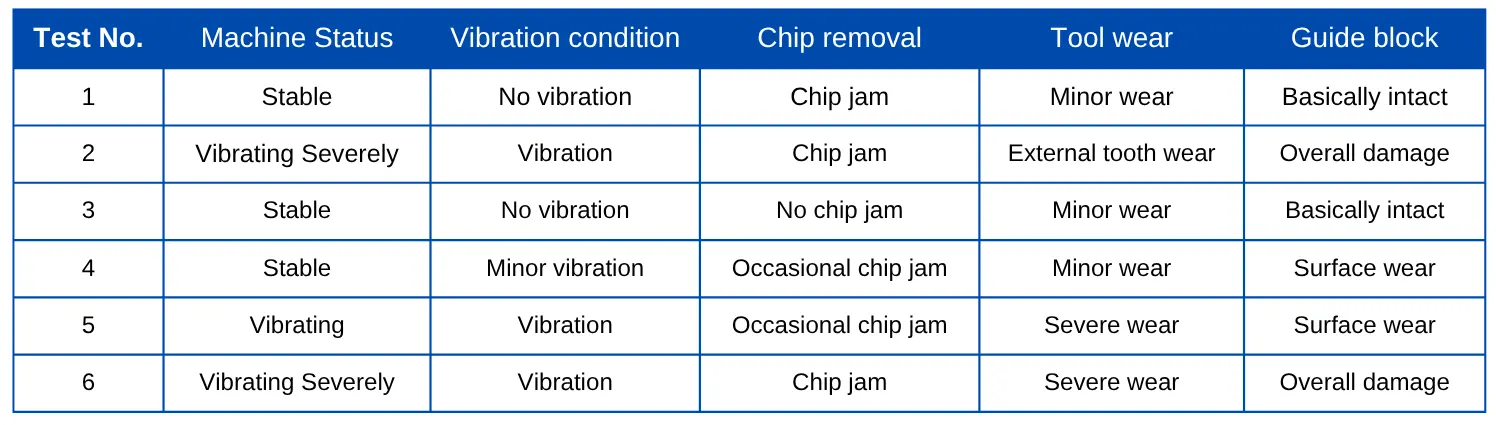
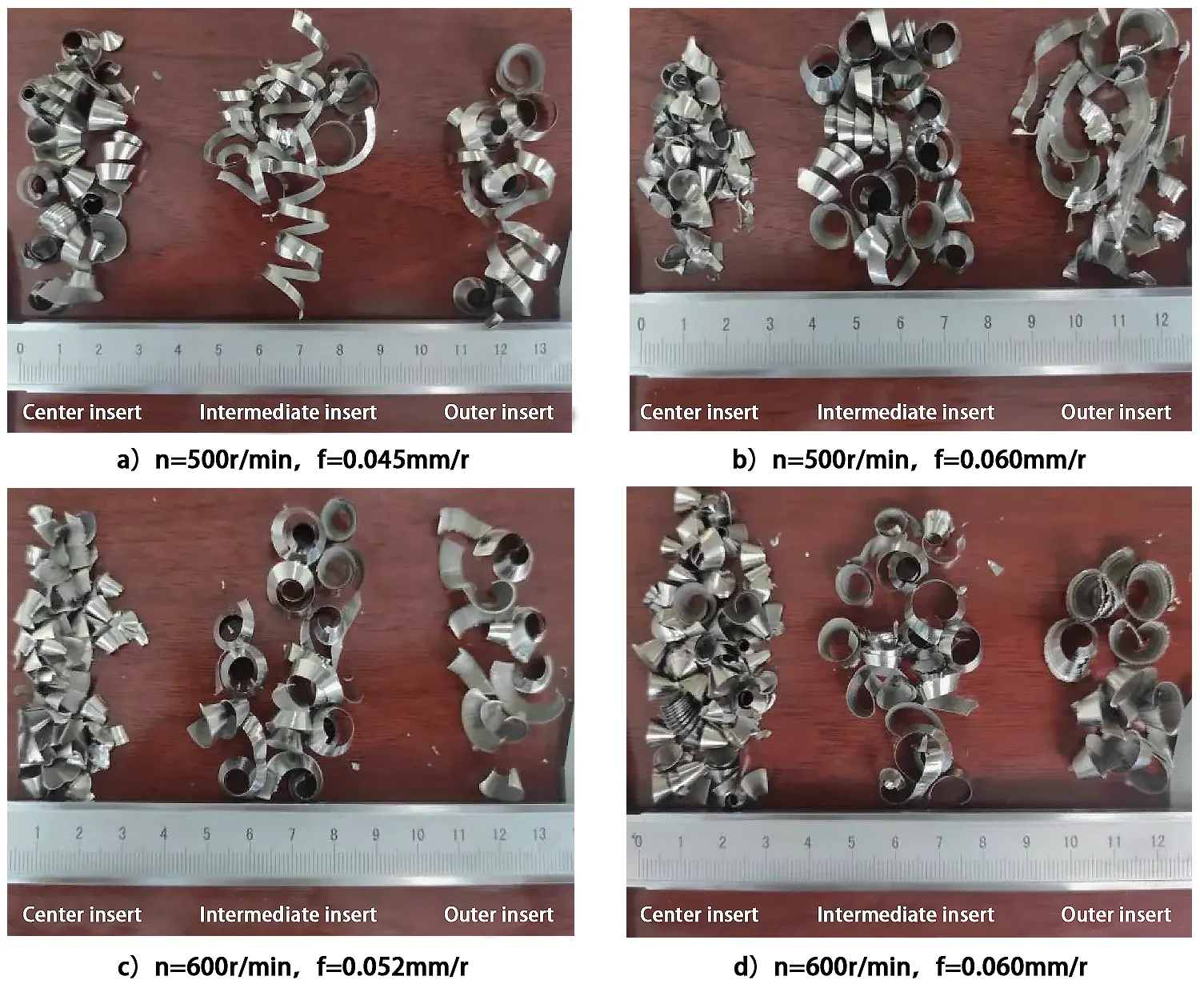
The chip morphology under different cutting parameters is shown in Figure 6, and the experimental processing conditions are shown in Table 4.
When the rotational speed n = 500 r/min, the feed rate f = 0.045 mm/r, and the coolant flow rate Q = 50 L/min, the resulting chips are shown in Figure 6a.
At low rotational speeds, the machine tool operates smoothly, the feed rate is small, and the chips are thin.
The exit velocities Vch1 and Vch2 of the upper and lower surfaces of the chips do not differ significantly, and the chips do not curl upward noticeably.
Therefore, the intermediate teeth and outer teeth produce thin filamentous and ribbon-like spiral chips.
These chips have a high chip-carrying coefficient R value.
As a result, they are prone to chip buildup.
When the operator maintains the spindle speed at n = 500 r/min, they increase the feed rate to f = 0.060 mm/r.
They also increase the coolant flow rate to Q = 70 L/min.
Under these conditions, the machine tool and drill rod exhibit significant vibration.
The chips formed are shown in Figure 6b.
The feed rate f, cutting force, and chip thickness all increase.
When the chips flow through the chip evacuation groove on the front tool face, the outflow velocity Vch1V_{ch1} of the lower layer is significantly greater than that of the upper layer Vch2V_{ch2}.
As a result, the chips curl upward distinctly.
The central teeth and intermediate teeth normally break chips, producing spiral-curled short chips (pagoda-shaped chips).
The outer teeth show significant wear, with chips forming wide semi-circular chips and large C-shaped chips.
The chips exhibit obvious tear marks, and the chip capacity coefficient R value is high.
The guide block gets damaged, abnormal sounds occur, and cutting stops.
When the spindle speed increases to n = 600 r/min and the feed rate f = 0.052 mm/r, the coolant flow rate remains at Q = 70 L/min.
The machine tool operates smoothly, the tool holder remains stable, and the chips are as shown in Figure 6c.
The central teeth generate segmented chips, the intermediate teeth form spiral short chips, and the outer teeth create C-shaped chips.
The chip clearance coefficient R value is small, making chip evacuation easy.
The guide blocks remain intact, and the operator carries out the cutting process smoothly.
When the operator maintains the rotational speed at n = 600 r/min, they increase the feed rate to f = 0.060 mm/r.
They maintain the coolant flow rate at Q = 70 L/min.
Under these conditions, the machine tool operates smoothly, with only slight tool vibration.
The chips are as shown in Figure 6d.
The chip thickness increases, and obvious squeezing cracks are visible on the chip surface.
Occasional chip jamming occurs, and the guide block surface shows wear.
When the spindle speed increases to n=700 r/min, the feed rate f=0.052 mm/r, and the coolant flow rate Q=50 L/min, the spindle speed is too high, the coolant flow rate is too low, the machine tool vibrates, tool chatter is significant, and the tool and guide block wear severely.
Upon investigation, it was found that the material had a relatively high nickel content, and the coolant flow rate was low.
Severe adhesion occurred due to high temperature and high pressure.
This led to plastic flow on the contact layer between the tool’s front and rear cutting edges and the chips.
This resulted in the tool losing its cutting ability and subsequently breaking, necessitating frequent tool changes.
When the operator maintains the spindle speed at n = 700 r/min and increases the feed rate to f = 0.060 mm/r, they also increase the coolant flow rate to Q = 70 L/min.
Although the increased coolant flow rate ensures adequate lubrication and cooling, the high spindle speed and significant feed rate cause severe machine tool vibration.
Noticeable vibration occurs in the tool holder, making tool breakage likely during drilling.
As a result, they had to terminate the test.
The finished workpiece and inner hole are shown in Figure 7.


The combination of process parameters for drilling a 25 mm deep blind hole is as follows: spindle speed n = 600 r/min, feed rate f = 0.052 mm/r, and coolant flow rate Q = 70 L/min.
Under these conditions, the machine tool operates smoothly without tool vibration or chip jamming.
The tool experiences minimal wear, the guide blocks remain intact, and the chips form an ideal shape.
Chip removal is smooth, and the machining process proceeds without issues.